

TL;DR
This post details a specific workflow for using NotebookLM to efficiently study for the AWS Solutions Architect Associate exam, leveraging its AI-powered Q&A and source citation features to streamline revision.
Key takeaways
- NotebookLM excels over ChatGPT for exam prep by citing sources and handling large documents.
- Focus on high-quality, official AWS documents like the Exam Guide and Well-Architected Framework.
- Convert practice exam explanations and personal notes into sources for targeted revision.
- Use NotebookLM for quick, grounded answers to complex questions, citing exact document passages.
- An audio overview workflow turns commute time into productive study sessions.
Why NotebookLM beats a stack of PDFs for cert prep
I sat the AWS Solutions Architect Associate exam after spending six weeks studying mostly during my commute. I had two video courses on my phone, a 70-page exam guide PDF, three different practice-question banks, and a Notion full of notes I had stopped revisiting because the file had become unmanageable.
What actually moved the needle in the final two weeks was loading every one of those resources into a single NotebookLM workspace and using it as a study partner. By exam day I could ask “explain the difference between SQS and SNS again, but in the context of a fan-out pattern” and get a grounded answer in 30 seconds, citing the exact paragraph in the AWS whitepaper I had loaded the week before. This guide walks through the exact setup that worked, including what to load, how to structure your notebook, and the audio overview workflow that turned my drive to work into thirty minutes of revision.
Why NotebookLM specifically (and not just ChatGPT)
The question I get asked most often: why not just paste the AWS exam guide into ChatGPT and ask it questions? You can, but you will run into three problems. ChatGPT does not natively cite which document it pulled an answer from, so you cannot quickly verify against the source. The free tier has context limits that choke on long whitepapers. And it will happily make things up about AWS service quotas if it does not actually know.
NotebookLM solves all three. Every answer points back to the exact passage in your uploaded source. You can load up to 50 sources of meaningful length per notebook on the free plan. And when it does not know, it tells you the sources do not cover that question rather than inventing a quota number.
For an exam where wrong information is worse than no information, that grounding matters. The whole point of cert prep is internalising what AWS actually says, not what an LLM thinks AWS probably says.
What to load into your AWS notebook
Resist the urge to dump everything you have ever read about AWS. Quality of sources beats quantity, and a focused notebook produces better answers than one bloated with redundant material.
Here is the source list I used, in priority order:
- The official AWS Certified Solutions Architect Associate Exam Guide PDF. This is non-negotiable. It tells you exactly what is in scope. Download it from the AWS certification page and upload as the first source.
- The AWS Well-Architected Framework whitepaper. The exam draws heavily on its five pillars (operational excellence, security, reliability, performance efficiency, cost optimisation). Whole exam questions are paraphrases from this document.
- The AWS Disaster Recovery whitepaper covering the four DR strategies (backup and restore, pilot light, warm standby, multi-site active-active). Several questions on the exam map directly to this.
- Service-specific FAQs for the heavy hitters: S3, EC2, IAM, VPC, RDS, Lambda, ELB, Route 53, CloudFront, EFS, and EBS. Add these one at a time as separate sources so you can reference them by name.
- Your own typed notes from whichever video course you used. Convert any handwritten notes into a single document.
- Practice exam explanation packs. When you finish a practice exam, copy the explanations of every wrong answer into a single Google Doc and add it as a source. This is where most of your weak-spot revision will come from.
One thing not to load: random Reddit threads, YouTube transcripts, or anything where the underlying source is unclear. Garbage in, garbage out.
Setting up the notebook structure
Create one notebook called AWS SAA Exam Prep and resist the urge to split it into multiple notebooks for different topics. The whole power of NotebookLM is cross-source synthesis, and that breaks the moment you split your sources across notebooks.
Within the notebook, use the saved-notes feature to build three running documents that grow as you study:
- Weak topics. Anything you got wrong in a practice exam. Paste the question, the right answer, and a one-line “why I got this wrong” note.
- Service comparisons. Side-by-side notes on the questions everyone gets confused about: SQS vs SNS vs EventBridge, ALB vs NLB vs CLF, EBS vs EFS vs S3, RDS Proxy vs RDS read replicas.
- Decision trees. Short flow notes for the “which service should you choose” questions. Example: “Need durable, cheap object storage with lifecycle policies → S3 with Intelligent-Tiering or Glacier.”
These three notes are what you will revise from in the final week, not the original sources.
The audio overview workflow for commute studying
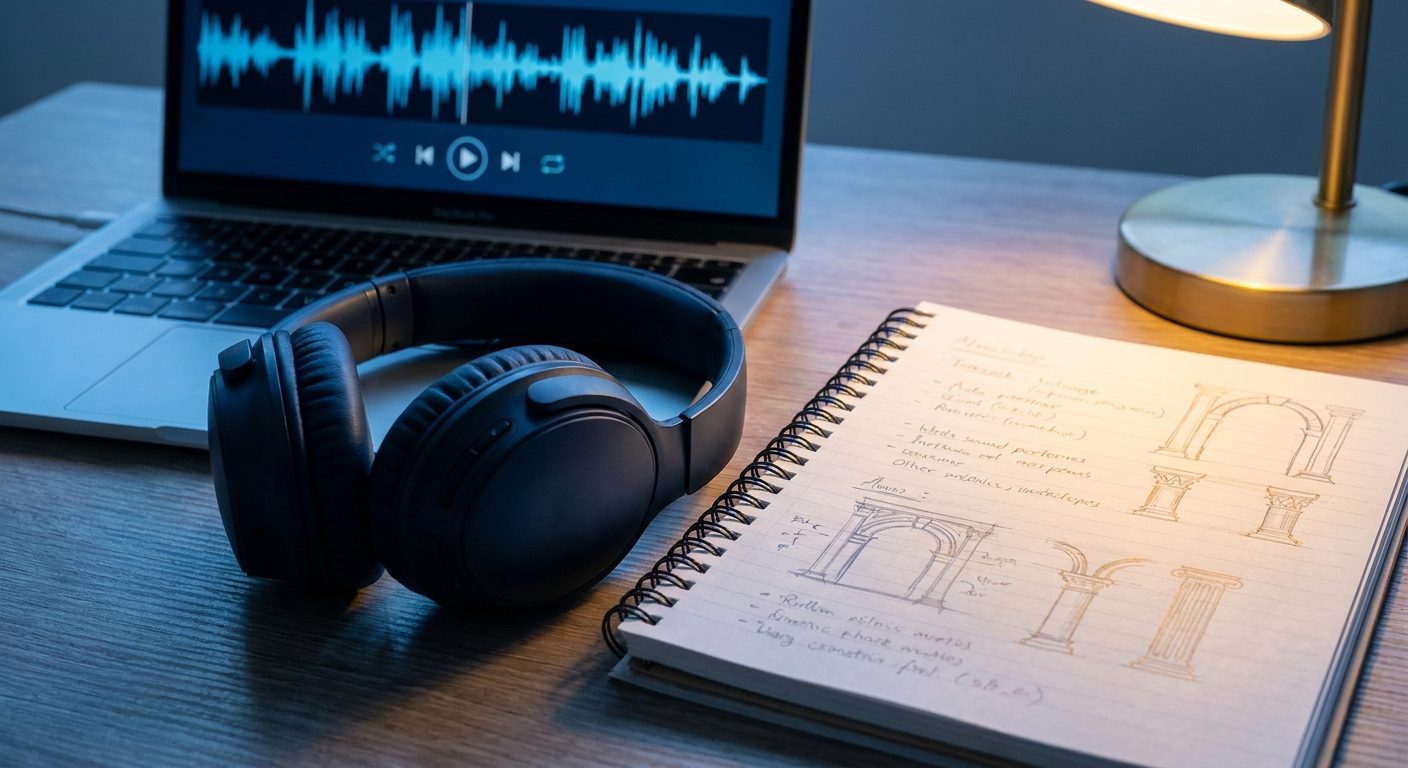
This is the feature that made the biggest difference for me. NotebookLM can generate a podcast-style audio overview of your notebook — two AI hosts having a conversation about your sources — and the result is genuinely usable as passive study material.
What I did, weekly:
- Pick a focus theme for the week (e.g. “networking and VPCs”).
- Customise the audio overview prompt to focus only on that theme — something like “Generate a deep-dive conversation focused on Amazon VPC, subnets, route tables, NAT gateways, VPC endpoints, and Transit Gateway. Compare design trade-offs and call out exam-relevant edge cases.”
- Generate a fresh overview each Monday.
- Listen during my commute, while cooking, while walking. Aim for three or four full listens that week.
The repetition does the heavy lifting. By the end of the week, the differences between a Transit Gateway and a VPC peering connection were burned in without me sitting down to memorise them.

Drilling your weakest topics with smart questions
Once a week, sit with the notebook for an hour and use the chat to drill the topics from your weak-topics note. The trick is to ask better questions than “explain VPC”. Generic questions get generic answers.
Better question patterns:
- Scenario flips. “If a question says I need a serverless event-driven workflow with at-least-once delivery and the ability to fan out to multiple consumers, which service combination is correct and why?”
- Compare and contrast. “Compare S3 Standard, S3 Intelligent-Tiering, S3 Glacier Instant Retrieval, and S3 Glacier Deep Archive on cost, retrieval latency, and minimum storage duration. Format as a table.”
- Trap-detection. “List the most common ways AWS exam questions try to trick candidates on IAM policies, with one example for each.”
- Edge cases. “What happens to data in an EBS volume when the attached EC2 instance is stopped, terminated, or hibernated?”
Save the answers you find genuinely useful into your saved notes. By the end of the cycle you will have a custom revision document that is more relevant to your weak spots than any pre-made cheat sheet.
The day-before-exam workflow
The night before, do not study new material. Open the notebook, open your three saved-notes documents (weak topics, service comparisons, decision trees), and generate one final 20-minute audio overview asking it to summarise everything you flagged as weak.
Listen to it once on the morning of the exam. Eat properly. Show up rested. The information is in. The job at this point is not to learn more — it is to retrieve cleanly.
What NotebookLM cannot do
Be honest with yourself about the limits.
- It cannot replace hands-on practice. You still need to spin up a free-tier AWS account and actually create a VPC, attach an internet gateway, and break things until you understand them.
- It cannot grade you. Use a real practice exam platform for timed full-length tests.
- It cannot keep you accountable. The notebook does not care whether you opened it today.
- It cannot teach you what is not in your sources. If you skipped loading the disaster recovery whitepaper, do not expect it to know that material.
Use NotebookLM as the synthesiser between your study materials, not as the materials themselves.
Closing
I passed the exam at 829 out of 1000 on a first attempt, and I credit the final two weeks of NotebookLM study more than any single video course. The setup takes about an hour. The audio overview habit takes ten minutes a week to maintain. The weak-topics drilling takes one focused hour a week.
For a certification with a real cost attached and a real career signal on the other side of it, that is a small amount of structure for a meaningful upgrade in how the material lands. If you are studying for SAA-C03 right now, set up the notebook this weekend. The compounding starts the moment you do.
Related reading
About the author
Shahid Saleem writes PickGearLab — a practical blog about AI tools, tutorials, and automation workflows for people who want real results, not another listicle. Certified in Microsoft AZ-900, CompTIA Security+, and AWS AI Practitioner, with 10+ years in enterprise IT.
→ Connect on LinkedIn · More about Shahid · Latest posts
New workflows, straight to your inbox.
Workflows like this one, as they are published. Free. Unsubscribe in one click.
Subscribe free →


2 responses