
Voxtral TTS has arrived, and it is already shaking up the AI voice generation landscape. Mistral AI released this open-weight, 4-billion-parameter text-to-speech model on March 26, 2026, and early benchmarks show it outperforming ElevenLabs in naturalness while offering developers free access to the weights. For anyone building voice assistants, podcasting tools, or enterprise customer support systems, Voxtral TTS is a model worth paying close attention to right now.
What Is Voxtral TTS?
Voxtral TTS is Mistral AI’s first major entry into the text-to-speech space, marking the French AI lab’s expansion beyond large language models into audio generation. The model converts written text into natural-sounding speech across nine languages, with a design philosophy centered on low latency, high expressiveness, and open accessibility. Unlike many commercial TTS offerings, Mistral is releasing the weights under a CC BY NC 4.0 license on Hugging Face, making it accessible to researchers and developers without a paywall.
The model is built on a three-part architecture: a 3.4-billion-parameter transformer decoder backbone, a 390-million-parameter flow-matching acoustic transformer, and a 300-million-parameter neural audio codec. This modular design allows each component to specialize, resulting in a system that is efficient enough to run on modern consumer hardware, including mid-range desktop GPUs and even some high-end laptops.
Voxtral TTS is not just an open-source curiosity — it is production-ready. Mistral has made it available via API at $0.016 per 1,000 characters, and developers can test it immediately inside Mistral Studio or Le Chat, the company’s chat interface.
A Surprisingly Compact Architecture
What makes Voxtral TTS technically interesting is how much capability Mistral has packed into a relatively small model. At 4 billion parameters total, it is significantly lighter than many commercial TTS systems, yet it delivers real-time performance with a time-to-first-audio latency of just 90 milliseconds — fast enough for interactive voice applications. The internal benchmark puts typical latency at 70ms for a 500-character input with a 10-second voice sample.
The real-time factor (RTF) of approximately 9.7x means Voxtral generates audio nearly ten times faster than real-time playback speed. In addition, the model can natively generate up to two minutes of continuous audio in a single pass, removing the need for chunking workarounds that often degrade naturalness in longer outputs. However, the most impressive technical feat may be the flow-matching acoustic transformer, which handles prosody, emotion, and rhythm with a level of nuance typically reserved for much larger models.
Because the model runs efficiently on consumer hardware, developers can self-host it without expensive cloud infrastructure. This means a startup building a voice assistant can deploy Voxtral on a single GPU server rather than paying per-character fees to a third-party provider indefinitely.
Voice Quality That Rivals ElevenLabs
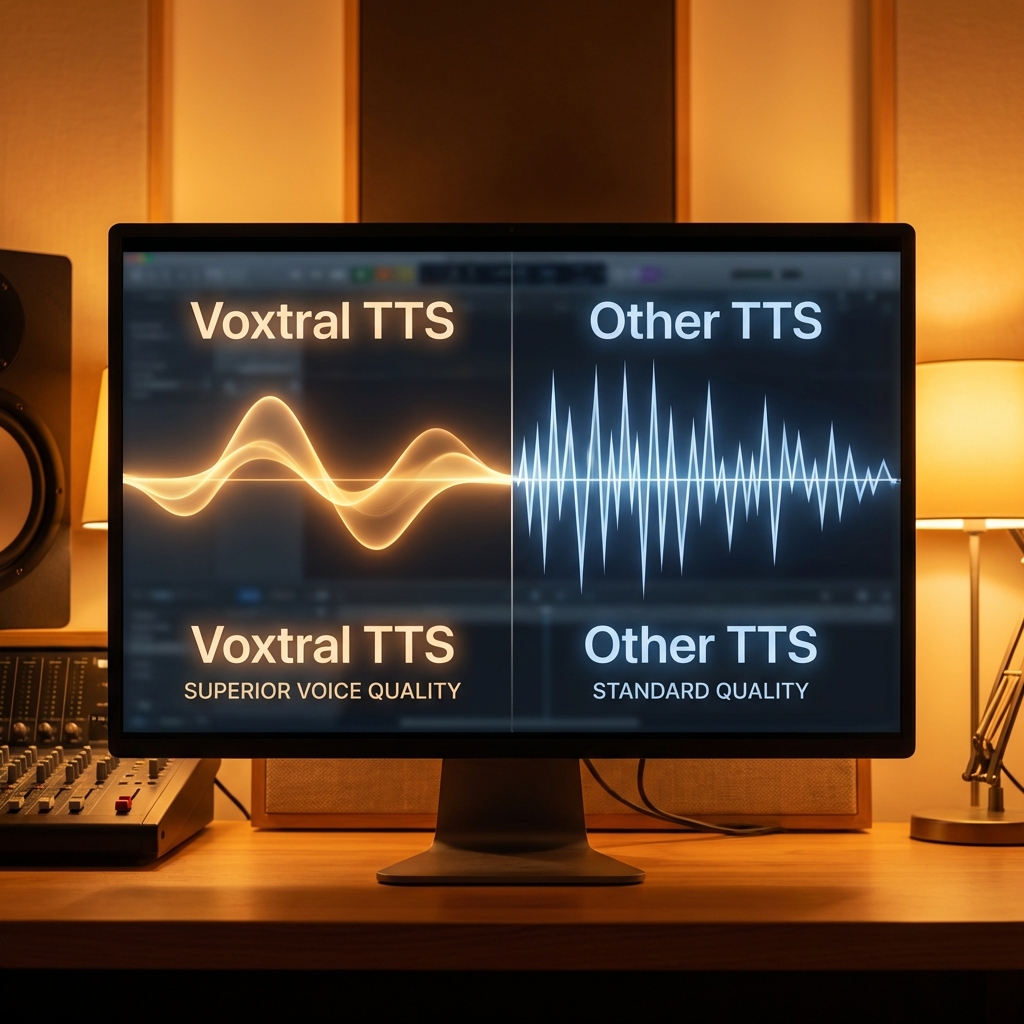
Mistral did not just release a functional TTS model — it released one that it claims beats the market leader. Human evaluation benchmarks conducted by Mistral show that Voxtral TTS achieves superior naturalness compared to ElevenLabs Flash v2.5 while maintaining a similar time-to-first-audio. For reference, ElevenLabs Flash v2.5 has been widely considered one of the fastest and most natural-sounding commercial TTS systems available. Voxtral also performs at parity with ElevenLabs v3 in overall quality.
These are bold claims, and independent developers testing the model have largely confirmed the competitive performance. The model handles punctuation-driven emphasis, emotional undertones, and sentence-level rhythm in ways that feel more natural than many alternatives at this price point. For example, the same sentence with different punctuation or capitalization produces noticeably different speech patterns, suggesting strong prosody modeling.
As a result, content creators, podcast producers, and enterprise developers now have a high-quality, low-cost alternative to ElevenLabs that they can also run entirely on their own infrastructure if needed. This dual availability — API plus self-hosted weights — is a competitive advantage that few commercial TTS providers can match.
Multilingual Support and Zero-Shot Voice Cloning
Voxtral TTS supports nine languages out of the box: English, French, German, Spanish, Dutch, Portuguese, Italian, Hindi, and Arabic. This covers a substantial share of global internet users and makes the model immediately useful for international applications without fine-tuning. Importantly, Mistral has built in zero-shot cross-lingual voice adaptation, which means the model can synthesize speech in one language using the voice characteristics of a speaker recorded in a different language.
This cross-lingual capability is particularly valuable for global businesses. For example, a company could record a single English-speaking brand voice and then deploy that same voice identity for Spanish or Arabic customer support — without hiring new voice talent or running separate recording sessions. The voice characteristics, including accent, tone, and emotional quality, transfer across languages naturally.
Voice cloning requires as little as three seconds of reference audio. This low barrier makes the feature practical for personalization at scale. Developers building voice agents can pass a brief audio snippet at inference time and receive a cloned output that preserves the reference speaker’s identity throughout the conversation. This stands in contrast to many competing systems that require 30 seconds or more of reference audio for comparable results.

Real-World Use Cases for Developers and Businesses
The combination of low latency, open weights, multilingual support, and rapid voice cloning makes Voxtral TTS versatile across a wide range of applications. Customer support automation is an obvious fit — businesses can deploy conversational voice agents that respond in under 100 milliseconds, supporting customers in their native language without the costs of human voice talent or expensive proprietary APIs.
Audiobook and content production is another strong use case. Writers and publishers can generate narrated versions of their content in multiple languages from a single source file, dramatically reducing production timelines. In addition, interactive voice response (IVR) systems for telecom and healthcare stand to benefit from the model’s naturalness, replacing robotic-sounding legacy systems with more engaging, human-like interactions.
For developers building AI agents and assistants, Voxtral TTS slots naturally into multi-modal pipelines. Its low latency makes it suitable for real-time voice interfaces, and its self-hostable nature makes compliance-sensitive deployments in healthcare or finance far more feasible than relying on cloud-only APIs. This means organizations with strict data privacy requirements can run the full voice pipeline on their own servers.
How to Access Voxtral TTS and Pricing
Accessing Voxtral TTS is straightforward. Developers can test the model immediately on Mistral Studio or through Le Chat at mistral.ai. The API endpoint is live and priced at $0.016 per 1,000 characters, which competes favorably with ElevenLabs’ pricing structure, especially for high-volume use cases. A 1,000-word article contains roughly 5,500 characters, meaning narrating a full article costs approximately $0.09 via the API.
For those who prefer to self-host, the model weights are available on Hugging Face under the model ID mistralai/Voxtral-4B-TTS-2603, licensed under CC BY NC 4.0. This license allows free use for non-commercial purposes, with commercial use requiring the API or a separate licensing arrangement with Mistral. The model runs on most modern GPUs, and Mistral has confirmed compatibility with consumer-grade hardware including mid-range desktop cards.
However, note that the CC BY NC 4.0 license restricts commercial self-hosting to API customers. Startups and enterprises planning to build revenue-generating products on top of the self-hosted weights will need to contact Mistral about commercial licensing terms before deploying at scale.
Final Thoughts
Voxtral TTS represents a significant step forward for open-weight voice AI. Mistral has delivered a model that is genuinely competitive with the best commercial offerings, priced affordably, and accessible via open weights — a combination that rarely comes together in the TTS space. For developers tired of being locked into proprietary voice APIs, this is a compelling alternative that does not require sacrificing quality or performance.
As a result, the competitive pressure on ElevenLabs, OpenAI’s TTS offerings, and Google’s voice APIs just increased substantially. When a well-funded, technically credible lab releases open weights that match or exceed commercial performance at a fraction of the cost, the market has to respond. This means that 2026 may well be remembered as the year that high-quality voice generation became truly commoditized.
At PickGearLab, we will continue tracking how Voxtral TTS performs in real-world developer deployments and enterprise use cases. Bookmark this page and check back as independent benchmarks and community feedback roll in over the coming weeks.




Leave a Reply