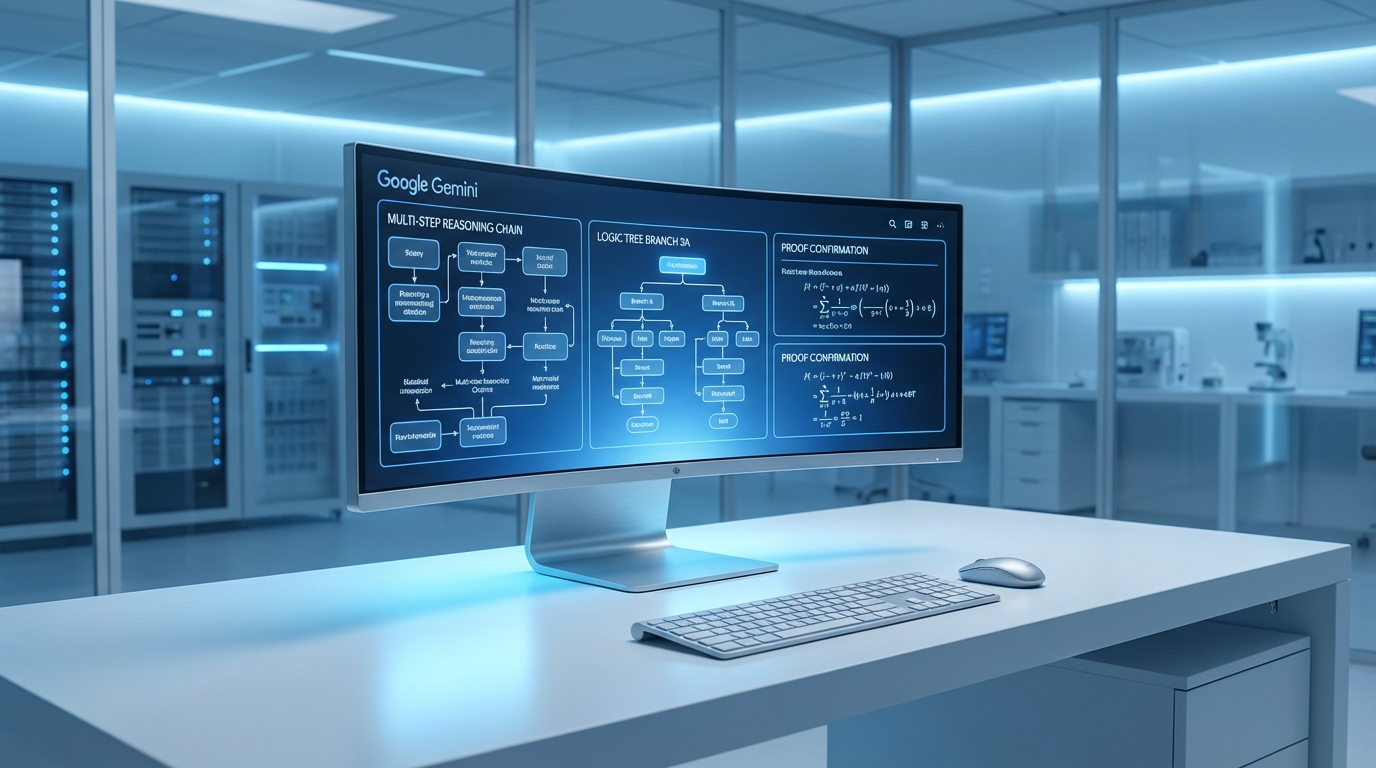
Google just unlocked its most powerful reasoning mode yet. Gemini 3 Deep Think, now available to Gemini Ultra subscribers, represents Google’s most ambitious push into frontier scientific and engineering reasoning — and the early results are genuinely impressive. This isn’t Gemini with a longer context window or faster response times. This is a fundamentally different mode of operation designed for problems that require extended, multi-step reasoning and expert-level accuracy.
Here’s a full breakdown of what Deep Think is, how it works, who it’s for, and what it means for the state of AI reasoning in 2026.
What Is Gemini 3 Deep Think?
Deep Think is a reasoning mode built into Gemini 3 that activates extended chain-of-thought processing for complex queries. When you submit a problem to Deep Think, the model doesn’t just generate a response — it works through the problem systematically, considering multiple approaches, checking its own intermediate steps, and refining its answer before presenting a final response.
Think of it as the difference between asking someone a quick question and asking them to sit down, think it through carefully, and give you their considered answer. The output takes longer — Deep Think responses can take anywhere from 30 seconds to several minutes depending on complexity — but the accuracy and depth of reasoning is substantially better than standard Gemini 3 output for hard problems.
Google is targeting Deep Think specifically at scientific reasoning, advanced mathematics, complex engineering problems, and multi-variable research synthesis. These are domains where the step-by-step integrity of reasoning matters as much as the final answer.

How Deep Think Works Under the Hood
Deep Think uses a technique called extended chain-of-thought reasoning combined with a self-verification loop. When the model generates an intermediate reasoning step, it evaluates that step for logical consistency before proceeding to the next. If it detects a potential error or inconsistency, it backtracks and tries an alternative approach.
This is meaningfully different from standard transformer inference. In a typical generation, the model moves forward one token at a time without revisiting earlier reasoning. Deep Think introduces a more deliberate process — slower, more expensive, but far more reliable for problems that require sustained logical integrity over many steps.
Google has also integrated domain-specific tool use into Deep Think. For scientific queries, the model can call specialized computation tools, look up established formulas, and verify numerical results programmatically before including them in its response. This dramatically reduces the hallucination rate for quantitative reasoning tasks.
Benchmark Performance
Google has published benchmark results showing Deep Think’s performance on several established reasoning evaluations. On the GPQA Diamond benchmark — a graduate-level science Q&A test — Deep Think scores 91.2%, compared to 74.3% for standard Gemini 3. On AIME 2025 math competitions, Deep Think achieves 89.4% accuracy. On FrontierMath, a set of unsolved research-level mathematics problems, Deep Think solves 42% — a significant improvement over both GPT-5 (31%) and Claude Opus 4 (28%) on the same benchmark.
These numbers represent a meaningful capability gap for specialized reasoning tasks. For users who regularly work with complex mathematics, scientific literature, or engineering design problems, Deep Think is not a marginal improvement — it’s a qualitative change in what’s possible.

Who Is Deep Think For?
Deep Think is clearly positioned for a professional and research audience. The use cases where it genuinely shines are specific and demanding.
Research scientists can use Deep Think to work through experimental design problems, analyze statistical results, and reason about causal relationships in complex datasets — tasks that require sustained logical rigor rather than just pattern matching.
Engineers and mathematicians will find Deep Think valuable for proof verification, optimization problems, and multi-constraint design challenges where standard AI tools often produce plausible-looking but incorrect answers.
Medical and pharmaceutical researchers can apply Deep Think to drug interaction analysis, clinical trial design, and literature synthesis — domains where accuracy is critical and errors have real consequences.
Advanced students and academics working on graduate-level coursework will find a capable reasoning partner that can work through difficult proofs, derivations, and conceptual problems step by step.
Access and Pricing
Deep Think is currently available exclusively to Gemini Ultra subscribers, which costs $19.99 per month in the US. Google has indicated that access may broaden to lower subscription tiers later in 2026, but for now it remains an Ultra-exclusive feature — likely because the compute cost of extended chain-of-thought reasoning is substantially higher than standard inference.
API access to Deep Think is available to developers through Google’s Vertex AI platform. Pricing is usage-based and significantly higher than standard Gemini 3 API calls, reflecting the increased compute requirements. Enterprise teams that need Deep Think capabilities at scale should contact Google’s enterprise sales team for volume pricing.
How It Compares to OpenAI o-Series and Anthropic
Deep Think enters a competitive field. OpenAI has its o3 and o4-mini reasoning models, and Anthropic has been developing extended thinking capabilities in Claude. The key differentiator for Deep Think is its domain-specific tool integration — while OpenAI’s o-series models rely primarily on pure language reasoning, Deep Think actively uses computation tools to verify results, which gives it an edge on quantitative tasks.
Where OpenAI’s models have historically been stronger is speed and general-purpose usefulness. Deep Think is slower and more expensive, and its advantages are most pronounced on structured reasoning tasks rather than open-ended generation.
Final Thoughts
Gemini 3 Deep Think is the most capable scientific reasoning tool available to consumer AI users right now. If you’re working on problems that require sustained, verifiable logical reasoning — mathematics, science, engineering — and you’re currently relying on standard AI tools, Deep Think represents a genuine upgrade worth evaluating.
The $19.99 Ultra subscription is accessible for individual researchers and professionals, and the API availability means enterprise teams can integrate Deep Think into specialized workflows. Keep following PickGearLab as we track how Deep Think evolves and what it means for AI in professional and scientific settings.





Leave a Reply