Claude Mythos, Anthropic’s most powerful AI model to date, was accidentally exposed to the world this week through a massive internal data leak — and what the documents reveal is reshaping expectations for what AI can actually do. With dramatically higher scores across software coding, academic reasoning, and cybersecurity benchmarks than any previous Claude model, Mythos represents what Anthropic itself is calling “a step change” in artificial intelligence capability.
What Is Claude Mythos?
Claude Mythos is Anthropic’s next-generation large language model, positioned above the current Claude Opus 4.6 as the company’s most capable system ever built. Internally, the project carried two names during development: “Mythos” and “Capybara.” The name Mythos was chosen to evoke “the deep connective tissue that links together knowledge and ideas,” according to leaked internal documents.
The model introduces an entirely new fourth product tier — above the existing Claude Haiku, Sonnet, and Opus lineup. This “Capybara” tier is designed for enterprise clients and researchers who need the highest possible performance for demanding tasks, particularly in software engineering, scientific analysis, and cybersecurity research.
Anthropic confirmed the model’s existence to Fortune on March 27, 2026, after nearly 3,000 internal documents were inadvertently made public. The company stated that training is complete and early-access pilots have already begun with a small group of vetted organizations.
How a Configuration Error Exposed Anthropic’s Secret
The leak originated from a misconfigured content management system at Anthropic that had been left with default public-access settings. This single oversight exposed close to 3,000 internal assets, including product roadmaps, benchmark comparisons, capability assessments, and deployment strategy documents related to Claude Mythos.
Security researchers discovered the exposed cache and notified Anthropic, which quickly locked down the content. However, enough details had already circulated to confirm the model’s existence and core capabilities. In response, Anthropic chose transparency, confirming the project rather than issuing a denial.
The incident highlights a recurring challenge in AI development: as models become more powerful and commercially significant, protecting proprietary research from accidental exposure becomes increasingly difficult. For Anthropic, the breach accelerated a disclosure timeline the company had not yet finalized.
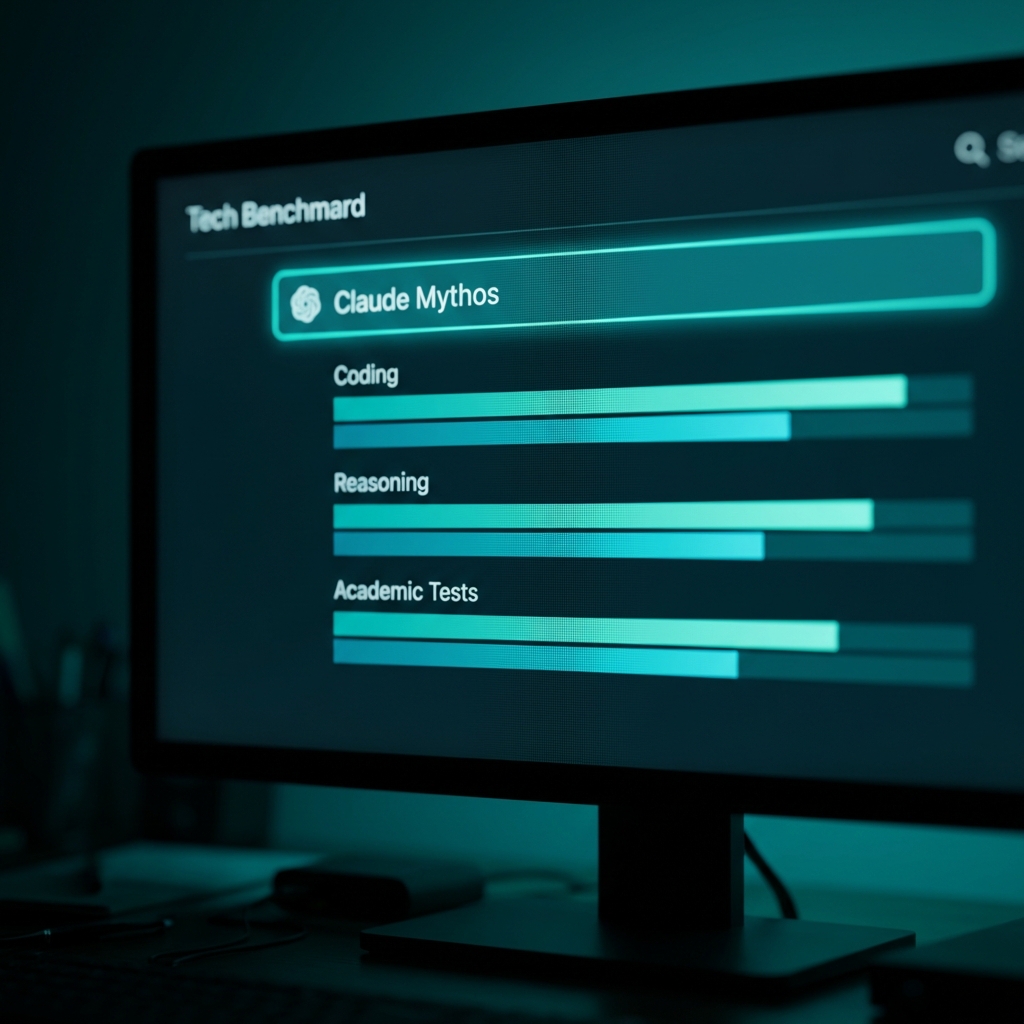
Groundbreaking Benchmarks: Coding, Reasoning, and Academic Tests
According to the leaked documents, Claude Mythos achieves “dramatically higher scores” across every major benchmark category compared to Claude Opus 4.6 — currently Anthropic’s top publicly available model. The performance gains are reported as substantial across software coding challenges, complex multi-step academic reasoning, and standardized AI evaluation tests.
In programming tasks specifically, Mythos reportedly demonstrates the ability to surface previously unknown vulnerabilities in production codebases — a capability that Anthropic acknowledges is “dual-use” in nature. The model also excels at long-horizon reasoning tasks, where it must plan and execute multi-step problem solving over extended interactions.
Anthropic describes the model as being positioned “far ahead of any other AI model in cyber capabilities,” a claim that, if accurate, places it above comparable offerings from OpenAI, Google DeepMind, and Meta. However, since these are internal documents rather than peer-reviewed benchmarks, independent verification has not yet occurred.
The Cybersecurity Dilemma: A Double-Edged Sword
Perhaps the most significant revelation from the leaked documents is how seriously Anthropic takes the security implications of Claude Mythos. Internal assessments warn that the model “presages an upcoming wave of models that can exploit vulnerabilities in ways that far outpace the efforts of defenders.” This is an extraordinary acknowledgment from an AI lab about the risks of its own technology.
As a result, Anthropic is deploying Mythos with an intentionally slower and more restrictive rollout compared to previous Claude models. The initial access group is limited to organizations evaluating the model specifically for defensive cybersecurity applications — companies looking to use Mythos to find and patch vulnerabilities in their own systems before malicious actors do.
This approach reflects a broader strategy Anthropic calls “responsible scaling”: only releasing models to wider audiences after demonstrating that safety measures are in place. For Mythos, that means giving defenders a head start before the model becomes widely accessible. The company has also reportedly coordinated with government cybersecurity agencies as part of this rollout process.
Pricing and Availability: Who Gets Claude Mythos First?
Anthropic has been candid about the economics of Claude Mythos: the model is “very expensive for us to serve, and will be very expensive for our customers to use.” This places it firmly in enterprise territory, targeting organizations with significant AI budgets rather than individual developers or small teams.
Early access is currently restricted to a small cohort of vetted customers, primarily in cybersecurity, financial services, and research institutions. The company has not announced a general availability date, though the confirmed completion of training suggests a broader rollout could come within weeks or months.
Anthropic is actively working to improve inference efficiency before scaling access — a process that could reduce per-query costs and make the model more accessible over time. For context, Claude Opus 4.6 already commands premium pricing compared to Claude Sonnet and Haiku; Mythos is expected to introduce a new pricing tier above all current offerings.

Market Reaction: Cybersecurity Stocks Take a Hit
Financial markets responded swiftly to the Claude Mythos leak. Shares of leading cybersecurity companies including CrowdStrike and Palo Alto Networks fell more than 5% following the announcement, as investors reassessed the threat landscape that AI-powered vulnerability detection could create.
The market reaction reflects a genuine concern: if AI models can identify and exploit software vulnerabilities faster than human security teams can patch them, the economics of the cybersecurity industry could shift dramatically. Companies that currently sell threat detection and response services may face an AI-driven disruption to their business models.
In addition, Anthropic’s revenue trajectory adds context to the significance of this release. The company is reportedly approaching $19 billion in annualized revenue, and Claude Mythos — with its premium pricing tier — is positioned to accelerate that growth significantly. For Anthropic, the leak may have forced an earlier-than-planned acknowledgment, but the underlying business case remains compelling.
Final Thoughts: What Claude Mythos Means for AI’s Future
The accidental leak of Claude Mythos offers a rare window into the accelerating pace of frontier AI development. In a matter of months, the gap between publicly available models and what top labs are actually building has widened considerably. Anthropic’s confirmation that Mythos represents a “step change” — not merely an incremental improvement — suggests the AI capability curve is steepening rather than plateauing.
For developers, enterprises, and policymakers, this raises urgent questions about governance, access, and safety. How do organizations prepare for AI tools that can outpace human defenders in cybersecurity? How do regulators keep pace with models that advance faster than any oversight framework can adapt to?
At PickGearLab, we will continue tracking Claude Mythos as Anthropic moves toward broader availability. Whether you are evaluating enterprise AI tools, building security workflows, or simply staying informed about the state of the art, Claude Mythos is a development you cannot afford to overlook. Bookmark PickGearLab for the latest updates as this story develops.





Leave a Reply